Short answer
The shortest possible answer to odysseus vs hermes vs openclaw is this: Odysseus is the broadest workspace, Hermes is the most obviously agentic learning system, and OpenClaw is the most assistant-first gateway. If you want to compare them seriously, do not compare slogans. Compare what each product actually tries to do every day.
This page is an agent workflow comparison, not a generic product scorecard. That framing matters because each product solves a different operational problem: workspace, agent learning loop, or always-on personal assistant routing.
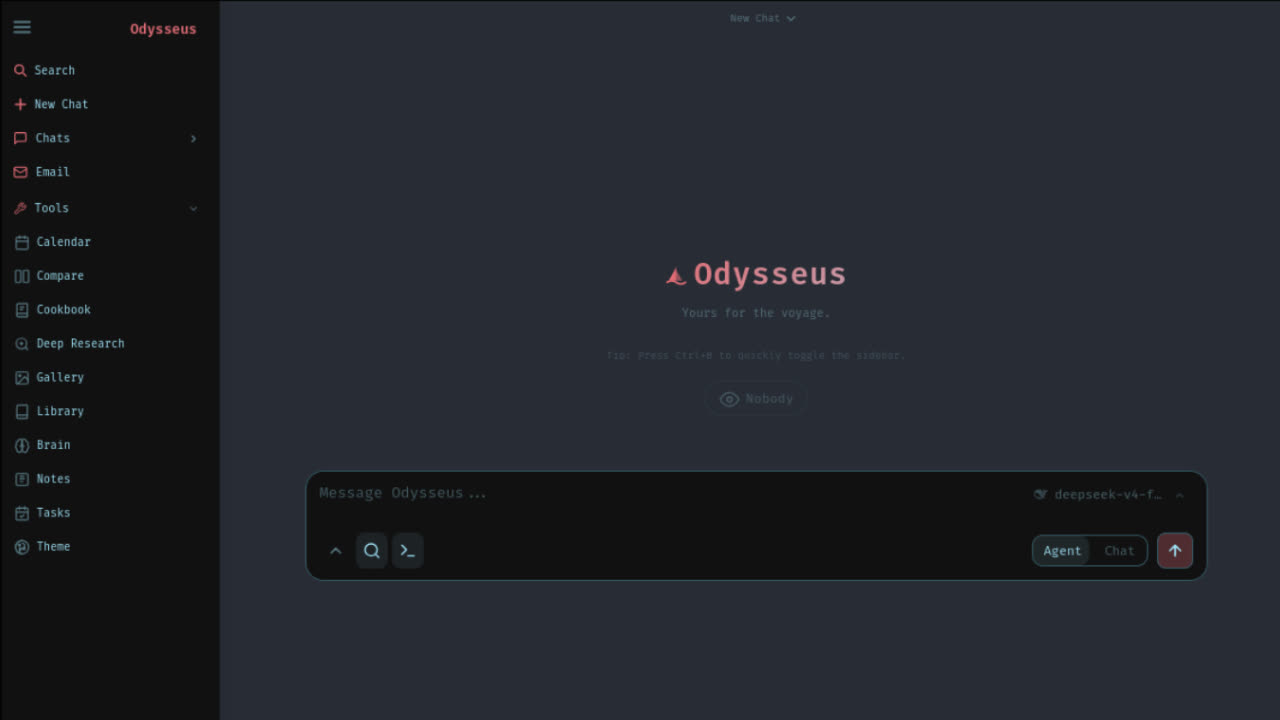
Odysseus tries to be a local ai workspace where you can chat, run agents, inspect files, keep memory, run research, and choose model endpoints. Hermes tries to be a self-improving agent that gets better across use, with skills, provider routing, and task execution. OpenClaw tries to be an always-on personal assistant that reaches you through the channels you already use.
That means the question is not “which one is objectively best.” The real question is whether you want a workspace, an agent, or a channel gateway. Once that category is clear, the product choice is much easier.
Source matrix: what each official project says it is
Before reading a feature comparison, verify the source labels. The official Odysseus repo describes a self-hosted workspace. The official Hermes docs describe a self-improving AI agent built by Nous Research. The official OpenClaw site and docs describe a self-hosted gateway and personal assistant. That source language is the most important fact in the whole odysseus vs hermes vs openclaw decision.
Odysseus AI
A self-hosted AI workspace that puts chat, agents, tools, file handling, research, documents, memory, and model routing into one local-first interface you control. Best when you want a workspace, not just an agent. Good for users who need model choice, source visibility, and a broader day-to-day environment.
Hermes Agent
A self-improving AI agent from Nous Research with a built-in learning loop, skill persistence, provider flexibility, terminal and messaging presence, and task execution behavior. Best when you want a self-improving odysseus ai agent-style system that learns from use, works across providers, and behaves more like an autonomous agent.
OpenClaw
A personal AI assistant and gateway that connects messaging surfaces and channels to AI agents, with an always-on control plane and assistant-first product framing. Best when you want an always-on openclaw ai agent experience across chat surfaces, channel plugins, and personal-assistant workflows.
If a summary page ignores these source labels, the page will drift into bad advice. A workspace does not behave like a learning agent, and a channel gateway does not behave like a browser workspace. The useful comparison starts with product identity, not with the user interface screenshot.
Feature matrix for practical use
This is the part most readers actually want when they search odysseus vs hermes vs openclaw. Treat the table as a job fit matrix. Use it to decide which one deserves your setup time, not which one wins a meaningless score contest.
| Factor | Odysseus | Hermes | OpenClaw |
|---|---|---|---|
| Category | Self-hosted AI workspace. It tries to combine chat, documents, research, tools, and model routing in one place. | Self-improving AI agent/framework. It is built around skills, learning loops, providers, and autonomous task execution. | Personal AI assistant with a gateway layer. It focuses on channels, messaging surfaces, voice, and assistant control. |
| Primary surface | Browser workspace and local app stack. The user sees a configurable workspace rather than only a single bot conversation. | Terminal, messaging platforms, and IDEs. The product aims to live across work surfaces and keep growing across sessions. | Chat apps and channel plugins. The gateway bridges WhatsApp, Telegram, Slack, Discord, and similar surfaces to the assistant. |
| What it is really good at | Running your own AI workspace with documents, model serving, local files, research, and a private control layer. | Building a learning agent that can persist skills, improve with use, and operate across providers and environments. | Being an always-on personal assistant that answers through the channels you already use and keeps the control plane local. |
| Setup burden | Moderate to high. You verify GitHub source, set environment variables, choose Docker or native setup, and decide on local or remote models. | Moderate to high. You need to understand providers, runtime behavior, skills, and the boundary between agent and infrastructure. | Moderate. You still configure the gateway, channel connectors, and model providers, but the channel-first flow can feel more direct. |
| Privacy boundary | You control the workspace and can keep more data local, but external APIs and tools still move data outside when configured. | You control the agent runtime, but the provider you connect to still defines what leaves the machine or server. | You control the gateway and channels, but messages, voice, or tool actions can still cross provider and network boundaries. |
| Best fit user | People who want a local ai workspace and are comfortable managing installation, files, and model setup. | People who want self hosted ai agents with a stronger learning loop and more autonomous task behavior. | People who want a personal assistant that lives in chat channels and keeps an always-on gateway running. |
The table makes one thing obvious: odysseus ai agent queries often point to a workspace problem, while hermes ai agent queries point to a learning-agent problem, and openclaw ai agent queries point to a channel-bridge problem. They overlap, but they are not identical.
If you only want a browser workspace with local models and documents, Odysseus probably deserves the first look. If you want an agent that can improve its own skills and persist knowledge across use, Hermes is the more natural fit. If you want a personal assistant that shows up in chat surfaces and stays reachable through a gateway, OpenClaw is the cleaner match.
You chose Odysseus. Now let's get you running, not just reading.
Launch Kit tells you exactly where. The bridge between "I chose Odysseus" and "I'm using Odysseus". Not more documentation, but a decision-making kit. The first night should be about exploring, not troubleshooting.
How to choose by job, not by hype
When the job is “give me a private workspace I can inspect,” Odysseus is the strongest fit because it is a self-hosted AI workspace first. It is more than a chat box, and that matters if you need documents, memory, research, file uploads, and model control in one environment.
When the job is “learn from use and keep growing,” Hermes becomes more attractive. Its official docs lean heavily into learning loops, skills, persistence, and provider flexibility. That makes Hermes feel closer to an agent framework than to a general workspace.
When the job is “stay available where I already talk,” OpenClaw is the clearest fit. The product is explicitly built around the assistant being reachable through messaging and channel surfaces. That is why it reads more like a personal assistant gateway than a browser workspace.
Choose Odysseus
Choose Odysseus when you want a local ai workspace with chat, agents, research, documents, memory, files, and model routing in one app.
Choose Hermes
Choose Hermes when you want self hosted ai agents with a learning loop, skills, provider flexibility, and agent behavior that improves with use.
Choose OpenClaw
Choose OpenClaw when you want a personal assistant that lives across chat channels and keeps an always-on gateway between you and the agent.
Cautions and edge cases
One common mistake is to ask for a “winner” before deciding the job. That is how users end up over-installing the wrong stack. A second mistake is to assume that all three products share the same privacy boundary. They do not. The workspace, the agent, and the gateway all have different control surfaces, different provider choices, and different ways to leak or protect data.
Not the same product class
This odysseus vs hermes vs openclaw comparison is helpful, but it is not a perfect apples-to-apples product review. Odysseus is a workspace, Hermes is an agent framework, and OpenClaw is a personal-assistant gateway.
Fast-moving project pages
Hermes Agent and OpenClaw both move quickly. Provider support, channel support, and feature names can change. Recheck the official docs before you build a setup plan around this page.
Workflow matters more than score
A “winner” only exists after you define the job. If you need local files, research, and an interface, Odysseus may fit better. If you need an always-learning agent, Hermes may fit better. If you need messaging-first assistant behavior, OpenClaw may fit better.
Another caution: project names can change the search intent around the edges. Some users type “Hermes AI” and mean Hermes Agent from Nous Research. Some users type “OpenClaw” and mean the assistant product, not just the gateway codebase. That is why this page uses the official project names instead of guessing at a generic label.
Finally, do not confuse “local” with “safe.” A self-hosted runtime may improve control, but you still need to manage secrets, logs, auth, channel permissions, model providers, and update discipline. The local ai workspace story is only helpful if the operator remembers that the agent is still powerful.
Official sources to verify before setup
Use the official links below if you want to check this odysseus vs hermes vs openclaw comparison against primary sources. Source verification matters more than social posts when the projects can run with model access, channel access, or tool access.
Recommended next guides
After you read this page, move to the guide that matches your next decision. If you want source legitimacy, read the GitHub guide. If you want a definition, read What Is Odysseus AI. If you want installation help, read the setup or download guide. If you want a simpler local model UI choice, read the Open WebUI comparison.
Source verification
Read the Odysseus AI GitHub guide if your next step is verifying the official repo, cloning safely, and avoiding fake installers.
Workspace definition
Read What Is Odysseus AI if you want a broader explanation of the self-hosted workspace, local models, and feature scope.
Open WebUI decision
Read the Open WebUI comparison if your job is mostly local chat, Ollama, and a lighter AI UI rather than a full workspace.
PewDiePie search intent
Read the PewDiePie Odysseus AI guide if the celebrity-linked search phrase is the reason you landed on this topic in the first place.
The practical takeaway from odysseus vs hermes vs openclaw is simple: define the workflow, verify the official source, then choose the category that fits the job. That order saves more time than chasing the loudest headline or the most shareable demo.
FAQ
What is the main difference in odysseus vs hermes vs openclaw?
The main difference is the product layer. Odysseus is a self-hosted AI workspace, Hermes is a self-improving AI agent framework, and OpenClaw is a personal assistant gateway that connects chat surfaces to agents.
Which one is closest to a local ai workspace?
Odysseus is the closest match if your priority is a local ai workspace with chat, documents, research, tools, and model routing in one environment. Hermes and OpenClaw are more agent-centric and channel-centric, respectively.
Which one is best for self hosted ai agents?
Hermes and OpenClaw are both strong candidates for self hosted ai agents, but they solve different jobs. Hermes emphasizes learning loops and skill growth. OpenClaw emphasizes assistant access through familiar channels and a local gateway.
Can Odysseus, Hermes, and OpenClaw all use local models?
Yes, but the model boundary depends on configuration. Odysseus is designed around model routing in a workspace. Hermes supports multiple providers and local model options. OpenClaw also depends on the providers you attach to its gateway and assistant stack.
Should I pick one based on a single benchmark?
No. A single benchmark will not tell you which workspace, agent, or gateway fits your daily use. Compare setup effort, channel surface, privacy boundary, provider support, and the job you actually want automated.