Quick verdict
Choose Claude if you want a managed cloud assistant that is available quickly, works across devices, handles writing and coding conversations well, and does not ask you to maintain infrastructure. Claude is the easier default for a non-technical user, a manager, a writer, a student, or a developer who simply needs a capable assistant open in a browser or desktop app.
Choose Odysseus AI if you want a self hosted ai workspace that you can inspect, run, connect to local models, connect to API providers, customize, and troubleshoot. Odysseus asks for more effort up front: GitHub source verification, Docker or native setup, .env files, localhost ports, model endpoint choices, and update discipline. That work buys you more control over the workspace layer.
The better decision is often to use both. Claude can remain the high-quality cloud assistant for drafting, reasoning, coding help, and fast document work. Odysseus AI can become the privacy first AI workspace for local model experiments, repeatable agent flows, personal knowledge workflows, and cases where you need to understand exactly which runtime receives which data.
Choose Odysseus AI when control matters
Pick Odysseus when you want a self hosted ai workspace, want to inspect the GitHub source, prefer local or chosen API model routing, and can maintain Docker, Python, Ollama, ports, and updates.
Choose Claude when speed matters
Pick Claude when you want a polished cloud assistant today, do not want to run infrastructure, and value Anthropic model quality, document help, coding support, and cross-device availability.
Use both when workflows split naturally
Many users should not treat this as a winner-take-all choice. Use Claude for high-quality cloud reasoning, then use Odysseus AI for private experiments, local model tests, and repeatable agent workflows.
Odysseus AI vs Claude comparison table
A useful Odysseus AI vs Claude comparison starts by separating product category from model quality. Claude is a hosted assistant and model product. Odysseus AI is a self-hosted workspace that can route work to different models depending on your configuration. Comparing them only as chat boxes misses the real tradeoff: local ai vs cloud ai, runtime ownership vs managed convenience, and workspace control vs polished default experience.
| Factor | Odysseus AI | Claude |
|---|---|---|
| Best default use | Self hosted ai workspace for users who want local control, source visibility, provider choice, agents, Cookbook, memory, and custom workflows. | Hosted cloud AI assistant for users who want polished writing, coding, reasoning, documents, research, desktop and mobile access, and managed accounts. |
| Privacy boundary | You run the workspace, choose the model endpoint, inspect setup files, and decide whether data stays local or goes to an API provider. | You use Anthropic hosted services, organization controls, product policies, and Claude privacy settings rather than owning the runtime. |
| Setup burden | Requires GitHub source verification, Docker or native setup, environment variables, ports, model endpoints, and troubleshooting discipline. | Requires account access and product onboarding, with no local Docker, Python, localhost, or Ollama setup for the normal web app. |
| Model choice | Can connect local models or API providers depending on hardware, latency, privacy target, and cost tolerance. | Uses Claude models and Anthropic product surfaces. It is strong when you specifically want Claude quality and hosted convenience. |
| Agent/workspace fit | Better when ai agents, Cookbook recipes, local tools, source control, and repeatable workflows matter more than consumer polish. | Better when quick answers, writing, coding help, file review, analysis, and managed collaboration matter more than self hosting. |
If your main question is “which answer quality is better,” you are not comparing equivalent layers. Claude quality comes from Anthropic models and hosted product design. Odysseus quality depends on the models and providers you connect, plus how well you configure local context, agents, memory, documents, and tools. That is why a Claude alternative can mean two different things: an alternative model, or an alternative workspace boundary.
Privacy and data boundary
Privacy is the strongest reason to consider Odysseus AI, but it is also the area where vague claims can mislead users. A self-hosted workspace does not automatically make every prompt local. If you run Odysseus locally and connect only local models, your prompt boundary can stay on your machine. If you connect hosted APIs, the relevant provider receives the request. The workspace is local, but the model boundary depends on your configuration.
Claude has a different boundary. You are using Anthropic hosted services, product privacy controls, account settings, organizational policies, and cloud infrastructure. That is simpler for most users, especially teams that want an approved vendor instead of self-managed infrastructure. It is also less direct runtime ownership than running a local workspace yourself.
The practical privacy first AI question is therefore not “which product says privacy more often.” It is: where is the interface running, where do prompts go, where are files stored, who controls access, who can recover the account, how are logs handled, and what happens when a workflow uses a third-party model provider? Odysseus gives you more of that decision tree. Claude gives you a managed cloud answer.
For sensitive experiments, private notes, internal research, or local model testing, Odysseus can be the better control surface. For normal writing, code review, brainstorming, and work where an approved cloud assistant is acceptable, Claude can be faster and easier. The strongest setup is usually a data classification rule: local-only work in Odysseus, general work in Claude, and no secrets in either system unless the policy permits it.
You chose Odysseus. Now let's get you running, not just reading.
Launch Kit tells you exactly where. The bridge between "I chose Odysseus" and "I'm using Odysseus". Not more documentation, but a decision-making kit. The first night should be about exploring, not troubleshooting.
Setup and operational burden
Claude wins setup for most people. You create or use an account, open the app, and start. The product handles hosting, model updates, availability, mobile and desktop access, and interface polish. You may still need admin controls, organization policies, or privacy review, but you do not need to debug localhost, Docker logs, Python versions, or Ollama endpoints.
Odysseus AI asks for a different relationship with software. You should start from the official Odysseus AI GitHub repository, inspect the README, choose Docker or native setup, copy the sample env file, run the stack, find ports, check logs, and connect models. If Docker cannot reach Ollama, if a native dependency is missing, or if a local model is too slow, you own that troubleshooting path.
That work is not a bug in the product category. It is the tradeoff. Local ai vs cloud ai is partly about operational ownership. Claude hides operations because Anthropic runs them. Odysseus exposes operations because you run the workspace. If you enjoy control, that is an advantage. If you just need a reliable assistant for a deadline, that is friction.
A sensible first route is to read the Odysseus AI GitHub guide, then the Odysseus setup guide, then the how to run Odysseus guide. If those steps feel too heavy, Claude is probably the better first assistant.
Agents, workspace features, and model choices
Claude is excellent when you want a thinking partner for writing, coding, analysis, study, ideation, file review, and research-style conversations. Anthropic presents Claude as an assistant for problem solving, coding, research, analysis, and creative work, with product surfaces that are meant to be ready before you build anything yourself. That is the value of a mature hosted assistant.
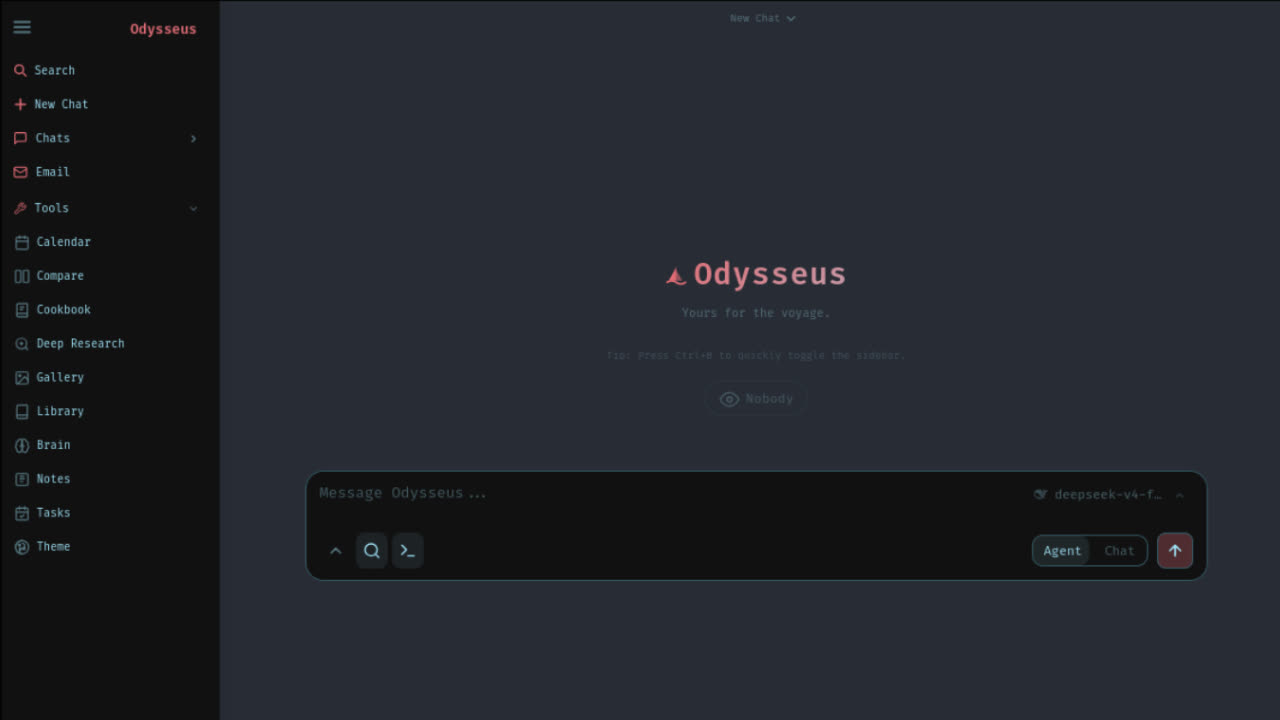
Odysseus AI is more interesting when the workspace itself matters. The official project describes a self-hosted AI workspace with chat, agents, Cookbook, deep research, compare, documents, memory, skills, notes, tasks, email, calendar, and related tool surfaces. In that context, ai agents are not just a checkbox. They are part of a wider attempt to turn repeated prompt patterns into controllable workflows.
The model choice is also different. Claude gives you Claude. That is the point. If you want Anthropic model behavior, a polished cloud product, and a simple place to ask for help, Claude is the direct route. Odysseus can use local models or API providers depending on how you configure it. That makes it more flexible, but also more variable. A small local model may be private and cheap but weaker. A hosted API model may be powerful but changes the data boundary.
Documents, research, and memory also split by control. Claude is strong when you want to upload, ask, summarize, draft, and iterate without managing a system. Odysseus is strong when you want your own workspace conventions around documents, memory, local models, comparison, and repeatable flows. If your research habit depends on source inspection and local records, Odysseus is a better workspace. If your habit depends on quick synthesis, Claude is a better assistant.
Cost, team use, and daily workflow fit
Avoid any comparison that pretends cost is only subscription price. Claude cost includes the plan, organization controls, API usage if you use the platform, and the value of not running infrastructure. Odysseus cost includes time, hardware, Docker or native maintenance, local model performance, optional API provider spend, backups, update discipline, and the opportunity cost of troubleshooting.
For a solo technical user, Odysseus can be attractive because the same machine can become a lab for local models, prompts, Cookbook recipes, and private workflows. For a non-technical team, Claude can be cheaper in the real world because people are productive immediately and do not need a maintainer for ports, logs, model endpoints, and local failures.
For a technical team, the choice depends on governance. If the team needs a vendor-approved hosted assistant with policy controls, Claude is a cleaner fit. If the team wants an internal experiment surface for local models, agent workflows, and open-source inspection, Odysseus AI deserves a pilot. A pilot should define allowed data, chosen models, owner, update cadence, backup behavior, and who is responsible when the stack breaks.
Day-to-day fit is the final test. If your work begins with “I need a strong answer now,” Claude is usually better. If your work begins with “I need to own the workflow, inspect the source, control the model route, and build repeatable local processes,” Odysseus is usually better. If both statements are true, split your workflow instead of forcing one tool to become everything.
Who should choose which
Claude is better for
Writers, students, managers, coders, analysts, and teams that want a managed assistant with polished defaults, cloud availability, and no local setup burden.
Odysseus AI is better for
Technical users, local AI hobbyists, privacy-sensitive experimenters, builders of repeatable workflows, and teams evaluating self-hosted AI workspace patterns.
Use both for
Cloud reasoning plus local experimentation: draft in Claude, prototype workflows in Odysseus, and reserve sensitive local-only tests for local model routes.
Avoid both for
Highly regulated data without approval, production automation without review, or workflows where no one owns security, backups, access control, and failure response.
If you are new to Odysseus, start with the what is Odysseus AI guide before installing. If you already know you want to try it, use the Odysseus AI download guide and then the Odysseus tutorial. If local models are the deciding factor, read the Ollama models guide.
The final Odysseus AI vs Claude decision is simple: Claude is the better first choice for immediate cloud productivity. Odysseus AI is the better first choice when the workspace boundary, source verification, local model routing, and configurable agent workflows are the reason you are searching.
FAQ
Is Odysseus AI a Claude alternative?
Odysseus AI can be a Claude alternative for users who specifically want a self-hosted workspace, local model routing, provider choice, and more control over the runtime. It is not a simple one-click replacement for Claude because Claude is a hosted assistant with managed infrastructure and Anthropic models.
Which is more private, Odysseus AI or Claude?
Odysseus AI gives you more control over where the workspace runs and which model endpoints receive prompts. Claude gives you Anthropic product privacy controls and hosted convenience. The practical privacy answer depends on whether you keep models local, connect API providers, upload sensitive files, and maintain your own server safely.
Can Odysseus AI use Claude models?
Odysseus AI is a workspace layer, so model routing depends on the providers and endpoints you configure. If you use any external model API, treat that provider as part of your data boundary and review the provider terms before sending private data.
Is Claude easier to set up than Odysseus AI?
Yes for most people. Claude is a hosted product. Odysseus AI requires source verification, setup, ports, Docker or native dependencies, and model configuration. That setup cost is the price of more runtime control.
Who should read this Odysseus AI vs Claude comparison?
Read it if you searched odysseus ai vs claude because you are deciding between a privacy first AI workspace you can run yourself and a managed cloud assistant you can use immediately.
The clean summary is this: Odysseus AI vs Claude is a workspace ownership decision more than a single answer-quality contest. Claude is the managed cloud assistant. Odysseus AI is the self-hosted workspace path. Your data boundary, maintenance tolerance, model strategy, and workflow design decide the winner.